Design Intelligence

Find the change order while it’s still a redline.

Proactive AI that reads your drawings, models, and specs — and surfaces what’ll bite you in the field.

The most expensive mistakes in construction are made before anyone breaks ground. Centauri reads your full drawing set, BIM model, and specifications together, cross-checks them, and marks up the issues most likely to become RFIs and change orders — while they’re still cheap to fix. It runs in your own cloud, so the drawings never leave the building.

Every problem you catch in pre-con costs a fraction of the same problem in the field.

~70%

of rework traces to design and engineering errors

FMI / CII syntheses

~5%

of project cost lost to field rework (range 2–20%)

CII

~800 RFIs

per project, ~$1,080 each — mostly design–field misalignment

Navigant

Read the whole set, cross-check it, and surface what matters

Centauri’s AI agents review drawings the way a great pre-con lead would — but across every sheet, model element, and spec section at once, and without the sensitive files ever leaving your environment.

1

Read everything

Ingest the 2D drawing set (PDF), the BIM model, and the specifications as one connected picture.

2

Cross-check

Compare a drawing against the spec that governs it and the model it came from, so conflicts between them surface instead of hiding.

3

Surface & mark up

Flag constructability issues, likely RFIs, clashes, code conflicts, and quantity gaps — called out directly on the drawing, with a human in the loop.

Catch what costs money

The issues most likely to become RFIs and change orders — marked up on the drawing.

Constructability, flagged. Details that can’t be built as drawn, missing dimensions, and access or sequencing conflicts, surfaced before they reach the field.

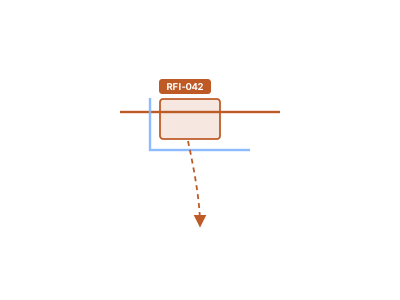
RFI-risk prediction. Centauri highlights the spots most likely to generate an RFI — the ambiguity a foreman would have called about at 6 a.m.

Marked up where you read it. Findings appear as callouts on the drawing sheet itself, not buried in a report — the same at-a-glance clarity as a redline.

Human in the loop. Every flag is a prompt for your reviewer, with the source drawing, spec section, and model element attached — so you catch the detail, not a confident guess.

➜ The conflict is already in the documents. The only question is whether you find it now, or the field finds it for you.

app.centaurivision.ca/design

1

2

3

Findings

1

Constructability — beam/duct conflict at grid C4; insufficient clearance

📐 A-341 rev C · 🧊 Model: Beam B-204

Confirm

Dismiss

2

RFI-risk — dimension missing, Detail 4/A-501

📐 A-501 · 🧊 Model: —

Confirm

Dismiss

3

Spec conflict — drawing calls Type X, spec 09 21 16 requires Type C

📄 Spec 09 21 16 · 📐 A-341 rev C

Confirm

Dismiss

Centauri reviewed 214 sheets · flagged 11 RFI-risks · 3 spec conflicts.

11 open findings · 3 high · linked to 27 sheets

CLASH

Grid C4 · Level 2

Beam B-204 conflicts with 24-inch duct run at grid C4

📐 A-341 rev C · 🧊 Beam B-204

SPEC

Detail 4 / A-501

Drawing calls Type X; governing spec requires Type C

📄 Spec 09 21 16 · 📐 A-341 rev C

Coordination & compliance

Clashes and code conflicts, found by cross-reading the set.

Clash & coordination: where the model and drawings disagree, or trades collide, surfaced with the elements involved.

Code & spec compliance: drawings checked against the governing specification and applicable code requirements, with the conflicting reference cited.

Drawing-to-spec-to-model consistency: the three sources reconciled, so a revision in one that wasn’t carried to the others gets caught.

Every finding traceable: each flag links back to the exact sheet, spec section, and model element — defensible in the next coordination meeting.

Takeoff & reliability

Quantities from the drawings — and a system you can actually trust.

Quantity takeoff

Extract counts and quantities from the drawings and model into a structured takeoff, with each figure traceable to where it came from.

Model cross-check

Reconcile quantities and elements between the 2D set and the BIM model, so the two don’t quietly disagree.

Proven on your own work

Centauri’s checks are measured on your own past projects, so you know where it’s reliable and where a person should make the call — reliability you can see, not a promise.

In your own cloud

Drawings and models are processed in your own environment; nothing sensitive leaves.

Quantity takeoff

Item

Count

Unit

Sheet

Doors — Type A

48

ea

A-201

CMU wall

1,120

A-341

Concrete — slab

312

S-102

1,240 items extracted · traceable

Check accuracy on your past projects

Clash

96%

Spec-conflict

91%

Takeoff

98%

Measured on your data

Works with the tools you already run.

Autodesk

Bluebeam

Procore

Runs in your cloud. Reads the design tools you already use.

Centauri deploys into your own cloud and reads from the design tools you already run — the drawings, models, and specs stay in your environment, which is exactly why estimators and VDC teams can use it on the files they can’t put through a consumer tool.

DESIGN IN

Design in

2D drawings (PDF), BIM models (Autodesk/Revit/IFC), specifications, Bluebeam markups.

CENTAURI IN THE MIDDLE

Centauri in the middle

Reads, cross-checks, and flags — proactively, with a human in the loop.

FINDINGS OUT

Findings out

Marked-up sheets, findings list, and takeoff, traceable to source.

Runs in your own cloud

Works with the AI models you trust

Proven on your own projects

No drawings leave your environment

Connectors to Autodesk, Bluebeam, Procore

Full audit trail

Ready to find the conflicts before the field does?

See Centauri review your own drawing set — in your own cloud — or enter your details to check pricing.

Get a demo